Flow Cytometry Had Considerable Impact on Implementation of Translational Medicine: However It Is Payback Time.
During the early days of AIDS, at the start of the 1980’s, the synchronous birth of a trilogy of technical advances was the culmination that paved the way to the production of clinical flow cytometers (1). This was an excellent example of how translational medicine can sublimate three seemingly unrelated fields of innovations into an apparatus to meet an existing clinical demand for immunophenotyping of leukocytes. The AIDS pandemic demanded rapid and reproducible lymphocyte immunophenotyping in resource rich countries (2). The implementation of large scale production of flow cytometers was possible because of three eclectic in nature inventions on hand. It included: compact personal computers, monoclonal antibodies with direct labeled fluorochromes and relatively cost effective powerful robust lasers.
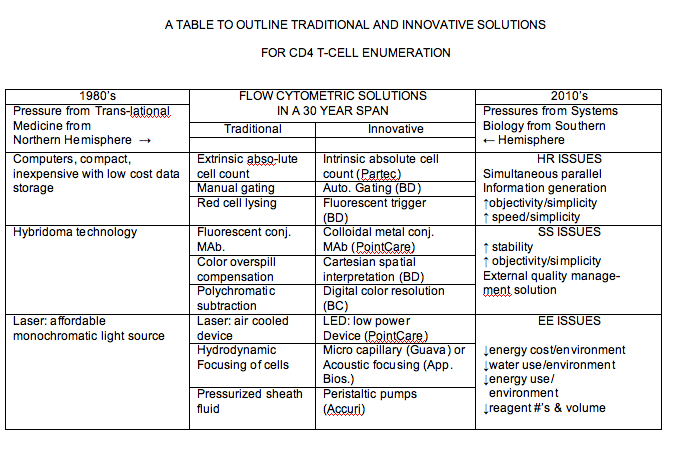
Thanks to rapid advancement in the development of anti retroviral pharmaceuticals, there is an excellent opportunity to eliminate the devastating impact of HIV, an infectious viral disease, in places such as sub-Saharan Africa (3). Cost effective drug cocktails are available in most of devastated regions. The remaining monumental challenge is the implementation of essential infrastructure to deal with vast rural regions for the effective administration of antiretroviral therapy (ART). The systematic administration of ART is an extremely challenging task. The antiretroviral drug distribution must be monitored meticulously to overt the possibility of an iatrogenic intervention, a viral mutation related to patient mismanagement that could lead to a new drug resistant strain variant of HIV. In response to the relentless international demand to treat millions more of HIV infected individuals in regions such as sub-Saharan Africa, there is some ongoing progress with immune status monitoring instrument development. While the choice for robust “time tested” instruments is still very limited, the number of innovative solutions to enhance current instrument capacity suitable for remote applications is promising. There has been steady progress in the past 15 years to find more robust and simpler execution of CD4 T-cell counting. Still, there is an enormous need for affordable robust inventions that can withstand hostile rural environment in order to support massive global implementation of ART. In this pursuit, most of the quintessential features associated with a traditional clinical flow cytometer have been discarded on many of the innovative new instruments (see Table). Some of the classical features considered essential for flow cytometry were eliminated, they include: hydrodynamic cell focusing, color compensation, use of laser as the monochromatic light source, use of fluorescent dyes for MAb tagging, use of sheath fluid, use of refrigerated reagents, reagent dependent absolute counting with single platform technology (SPT), manual specimen manipulation post phlebotomy, and the need for lysing reagent. Some of these innovative solutions may have profound impact on how future immunophenotyping will be performed.
At the beginning, it was critical to harness the three essential innovations to give life to clinical flow cytometry. Now, it is equally critical to bring a truly holistic human biology oriented management strategy that will overcome the limitations associated with rural remote locations without health infrastructure. In the 21st century, reversals of trilogies are required to solve the challenge facing humanity in many resource poor regions. It is in remote rural locations, where AIDS continues to ravage. To win the battle three essential crippling problems must be resolved. Build instruments that: (1) require minimal skills to operate, a human resources (HR) issue, (2) resolve sustainability issues such as elimination of refrigerated supply chain/storage, and access to pure water (SS), and (3) address effectively low energy/environmental requirements such as need for reliable electricity (EE) issues (4).
For the past 30 years, it is flow cytometry associated industries that profited the most from clinical diagnostic capacity stimulated by HIV disease, the impact of translational medicine (5). Clinical instruments purchased for CD4 T-cell enumeration proved to be useful for diagnosing some oncological diseases as well. In fact, diagnosing lymphomas and leukemia now are the bread and butter of these laboratories. It would be most appropriate if the flow community became part of the solution to eradicate AIDS. If the three above identified problems are effectively addressed in the next 5 years, via a platform approach integrating viral load and liver function assays on top of immune status monitoring, TB and malaria, there is a good chance for a sudden and dramatic global reduction of AIDS related deaths. Some of the essential instrumental requirements are all in the “Innovative” column in the Table.
Beyond magnificent altruistic accomplishments such as eradicating AIDS, perhaps even greater things are to unravel in the future. When in 1804 Joseph-Marie Jacquard in Lyon invented the programmable hand loom for silk weaving, the newly invented machines increased productivity 25 fold (6). But as sensational this accomplishment was during Napoleonic times in France, the punch-card principle that was incorporated into Jacquard’s weaving machine opened the world to binary nomenclature and the way to the world of computers. During the mid 19th century it was Charles Babbage who built computers such as the “Analytical Engine”. The programming was handled with punch-cards exactly as Jacquard had designed it to accelerate silk weaving. The French term for such programming was- “mise en carte” -which means -put into a card- this approach to store programming was valid up to the 1980’s (7). Are you ready to partake in a journey of clinical laboratory improvising where the instrument enhancement may lead to a future technology path well beyond our imagination?

Francis Mandy
International Centre for Infectious Diseases, Winnipeg, Manitoba, Canada
References:
1. Gottlieb, M. S., Schroff, R., Schanker, H. M., Weisman, J. D., Fan, P. T., Wolf, R. A., Saxon, A., Pneumosystis carinii pneumonia and mucosal candidiasis in previously health homosexual men. N. Engl. J. Med., 305, 1426, 1981.
2. Siegal, F. P., Lopez, C., Hammer, G. S., Brown, A. E., Kornfeld, S. J., Gold, J., Hassett, J., Hirschman, S. Z., Cunningham‑Rundles, C., Adelsberg, B. R., Parham, D. M., Siegal, M., Cunningham‑Rundles, S., Armstrong, D., Severe acquired immunodeficiency in male homosexuals, manifested by chronic perianal ulcerative herpes simplex lesions. N. Engl. J. Med., 305, 1439, 1981.
3. Gilks CF, Mugyenyi P, Hakim J, Reid A, Bray D, Darbishire LH, Gibb DM, and Babiker AG. Routine versus clinically driven laboratory monitoring of HIV antiretroviral therapy in Africa (DART): a randomized non-inferiority trial. Lancet on line, December 9, 2009.
4. Mandy F, Janossy G, Bergeron M, Pilon R, Faucher S. Affordable CD4 T-cell Enumeratio n for resource-Limited Regions: A Status Report for 2008. Cytometry B Clin Cytom. 74 Suppl 1:S27-39, 2008
5. Janossy G. Mandy F. Translational Medicine as Implementation Science in the Field of Monitoring HIV and TB. New Concepts Emanating from Resource-Poor Countries. Cytometry Part B, 78B 183-187, 2010.
6. EssingerJ. Jacquard’s Web. How a hand loom led to the birth of the information age. Oxford University Press. p. 37, 2004
7. EssingerJ. Jacquard’s Web. How a hand loom led to the birth of the information age. Oxford University Press. p. 282, 2004.