|
QASI, AN INTERNATIONAL QUALITY ASSURANCE PROGRAM TO ASSIST CD4 ENUMERATION IN RESOURCE LIMITED COUNTRIES
Infection by the human immunodeficiency virus (HIV) and eventual progression to death caused by advanced immunodeficiency syndrome (AIDS) remains one of the leading causes of worldwide morbidity and mortality. The majority of people living with HIV/AIDS reside in resource-limited countries. A range of programs aimed at improving global access to antiretroviral therapy have been effective in reducing the suffering and progression to AIDS caused by HIV, while demonstrating that the mobilization of massive public health interventions against the AIDS pandemic is possible. CD4 T-cell count is a pivotal indicator to initiate therapy and monitor antiretroviral treatment efficacy. Flow cytometry remains the most frequently used method to enumerate CD4 T-cells. There are currently a significant number of Flow-based technologic platforms operating worldwide often under hostile environments associated with deficiencies in both laboratory infrastructure and human resources (fig. 1). The provision of quality managed CD4 enumeration under these conditions is an enormous challenge.
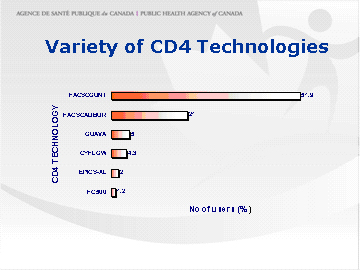
FIG. 1
In 1996, an international effort was initiated to assist with the quality management of infectious immunology laboratories in resource-limited settings. A leading clinical immunologist from the University of California-Los Angeles (UCLA), John Fahey, decided to take action to reduce the disparity in health care services between the Northern and Southern hemispheres. An international external quality assessment program for CD4-T cell enumeration was established to assist public health laboratories in resource-limited countries. His objective was to introduce the quality system approach to diagnostics. A partnership was created between UCLA, the University of Adelaide in Australia and Health Canada in Ottawa. During the XI International Conference on AIDS (Vancouver, Canada) with the theme “One World, One Hope”, the free external quality assessment program was officially launched. The new initiative was named Quality Assessment and Standardization for Immunological measures relevant to HIV/AIDS (QASI).
QASI is currently operated by the National Laboratory for HIV Immunology (NLHI) of the Public Health Agency of Canada, Ottawa. Over the past 15 years, the NLHI has formed close alliances with external stakeholders such as the World Health Organization (WHO), Centers for Disease Control and Prevention (CDC), the Clinton Foundation and several other organizations committed to facilitate global access to clinical laboratories quality assurance programs to manage infectious diseases, especially HIV/AIDS.
QASI has expanded to become a powerful and effective tool for assessing and sustaining quality laboratory management practices in resource constrained-regions. The quality management system involves an external quality assessment (EQA) program with an integrated quality improvement action plan, a customized biotechnology transfer workshop and the development of EQA management skills toward implementation of a national quality assessment program (fig.2). Thus, QASI is a quality management system designed to introduce the essential elements of laboratory based quality management culture in situation without experience.
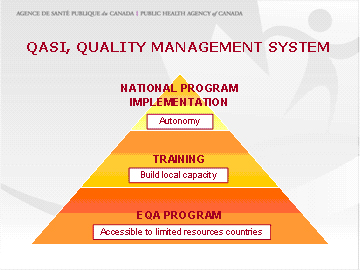
FIG. 2
QASI is designed specifically to support public health laboratories that are unable to afford the fees usually associated with commercial for-profit quality service providers. Three times a year, the program distributes a quality control panel with mid and low CD4 T-cell counts. Each cycle provides adequate time to assist laboratories that need to apply corrective measures prior to the next survey, a critical component of quality improvement (fig. 3). Ideally, all problems should be resolved prior to the next survey to continuously optimize the overall quality of the voluntary assessment program. A Web platform “QASI-LymphoSite.ca” gives all participants access to current and previous data submissions as well as performance reports. Performance reports include summary table of the statistical analysis, and graphic representation of current as well as historical performance for the last four participations.
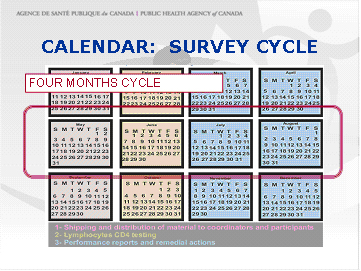
FIG.3
The QASI quality improvement team works closely with the national reference laboratory for remedial action follow-up, which is a critical part of developing the quality management and expertise of the national reference laboratory and developing its regional authority. QASI utilises its 15 years of experience to propose possible causes of deviation from acceptable performance to the national reference laboratory and assists in the remedial action if requested. This leadership-transfer strategy facilitates communication by bridging cultural differences. It also contributes to the development of national and regional guidelines in respect to what is required to succeed. The leadership role of the national reference laboratory is thus critical to the success of the quality management program. QASI considers the participation of national laboratory the pillar of quality management.
The long term objective of QASI is to assist with establishing independent national quality assessment coordinating centers in resource limited settings throughout the world. Therefore, many nations will manage autonomous quality assessment program in the future or at least obtain the skills to operate such programs. This option is provided to encourage the orderly establishment of the independent national quality management program. Once the domestic capacity is there, the national center can run their program independently. Based on pre-evaluation needs, QASI provides laboratory scientists with training to efficiently and rapidly upscale their quality laboratory management and training capacity. Workshops are specifically developed to address knowledge, expertise gaps and specific needs related to the CD4 T-cell enumeration technologies used in that country.
Participation in QASI is reaching nearly 700 clinical sites (fig.4). Thanks to the collaboration of 16 national reference laboratories with a deep commitment towards developing an implementation program in their respective regions or countries. The number of participants has steadily increased despite several countries who have established an independent National quality management program. Many have developed domestic capacity to run their program completely independently of QASI (South Africa, Brazil). The overall objective is for the National programs to achieve full autonomy; in this respect QASI strategy is atypical for a service provision organization.
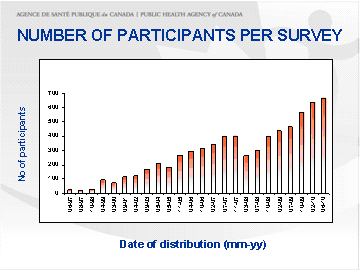
FIG.4
QASI has continued to evolve over the years to support the global requirement for the reliable delivery of CD4 –T cell enumeration services. While the quest for portable easy-to-use point-of-care (POC) devices is well on its way, EQA programs such as QASI will face new realities and will likely play a pivotal role for monitoring the performance of multiple devices in remote and adverse environmental and financial conditions. As POC devices will most likely accelerate the CD4 testing capacity, EQA program will have to meet these challenges to ensure access and globally accelerate management of CD4 T-cell enumeration. Over 15 years of existence, the QASI program has continuously demonstrated flexibility in tailoring the global need for quality assurance with innovative solutions developed in partnership with committed local leadership.

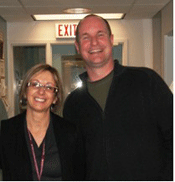
Michèle Bergeron and T. Blake Ball
NATIONAL LABORATORY FOR HIV IMMUNOLOGY
PUBLIC HEALTH AGENCY OF CANADA
|
