The Presidents Emergency Plan For AIDS Relief (PEPFAR) was a $15 billion program initiated by President George W. Bush to diagnosis and treat HIV/AIDS patients in resource-limited countries. PEPFAR increased the number of patients receiving antiretroviral therapy (ART) from approximately 50,000 to at least 2.1 million by early 2008.[1] PEPFAR was reauthorized in 2008 with a $48 billion commitment over 5 years to provide prevention, care and treatment programs for HIV/AIDS, malaria, and tuberculosis. The Lancet called PEPFAR "the largest and most successful bilateral HIV/AIDS program world-wide".[2] A recent study showed that the first three years of PEPFAR saved an estimated 1 million lives.[3]
To be effective a successful HIV/AIDS treatment program requires high quality laboratory support. To help develop this support, the American Society of Clinical Pathology (ASCP) Global Outreach partnered with the Center for Disease Control (CDC) to provide laboratory training and develop laboratory infrastructure in PEPFAR countries. In partnership with the host PEPFAR countries, ASCP’s Department of Global Outreach’s work includes laboratory assessment, technical assistance, clinical chemistry, hematology, laboratory management, phlebotomy, and education curriculum workshops, among other trainings. Since 2005 ASCP Global Outreach has partnered with 15 PEPFAR countries (Cambodia, Cote d’Ivoire, Ethiopia, Guyana, Haiti, Kenya, Lesotho, Mozambique, Namibia, Nigeria, Rwanda, South Africa, Swaziland, Tanzania, Vietnam) providing over 50 training sessions involving over 1500 in-country participants. The ASCP Global Outreach is composed of volunteers with expertise in laboratory medicine and ASCP support staff. The ASCP support staff provides logistical support while on assignment. They also serve as the primary contact between the ASCP and local healthcare organizations and hospitals.
The assessment of CD4 T-cell counts is one component of the ASCP's work. It is important because the monitoring of CD4 counts is critical in the clinical management of HIV/AIDS. It is especially important in resource limited countries where ART therapy is not usually initiated until the patient has a CD4 count of less than 350 cells/µL.[4] CD4 counts are also typically the only method of evaluating disease progression because HIV viral load testing is not usually available. The CD4 training consists of classroom lectures and a hands-on laboratory experience. The didactic portion covers the basics of HIV/AIDS, the principles of CD4 testing, basic laboratory operations and management, statistics, flow cytometer operation and maintenance, quality control, and quality assurance. The laboratory component consists of informal lectures and working with the instruments, with support from instrument manufacturers or their local distributors.
In March of 2010 David Grier, MD and Karla Gertis, MS, MT, (ASCP) taught basic and advanced CD4 courses at the National Public Health Reference Laboratory (NPHRL) in Georgetown, Guyana. Guyana is one of the poorest countries in South America with a per capita income of $3,800 (157th in the world) and has the 27th highest HIV prevalence rate in the world (2.4% of the adult population).[5]
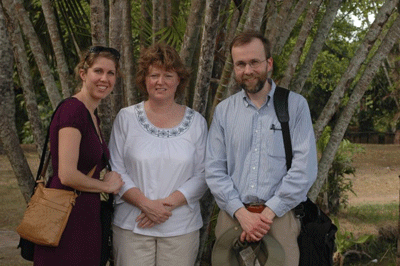
David Grier and Karla Gertis in Guyana with Marie Lehner from the ASCP.
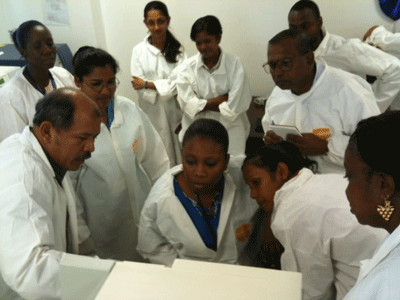
CD4 Training in Guyana.
The courses consisted of a week and a half long didactic classroom training complemented by hands-on laboratory experience including staining blood, acquiring data and then analyzing it. Additional topics included the pathology of HIV, how to prepare for a lab inspection, and flow cytometry of hematopoietic neoplasms. The students were composed of medical technologists and laboratory assistants from the NPHRL and from several laboratories outside of Georgetown.
In July 2008 another member of ICCS’s Education Committee, Paul Wallace, PhD, traveled to Abuja, Nigeria with a group from ASCP. The group was there to teach laboratory supervisors from across Nigeria. Participants were trained in Chemistry, Hematology or CD4 testing. Months before the training began, ASCP lay the groundwork with CDC and local representatives to design a customized program specifically for the host country. The program was designed to cover the materials and emphasis in each subject they wanted covered. In Nigeria, the CD4 testing program provided participants with not only advanced knowledge but also the teaching skills necessary to return home and train their co-workers. This “train the trainers” concept is one that ASCP/CDC utilizes in most of their educational programs. ASCP/CDC provides subsequent follow up and support by sending training materials and ASCP volunteers back to assess the new crop of trainers.
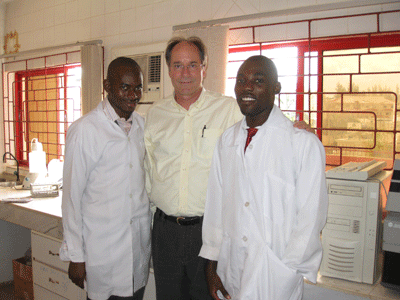
(Paul in Nigeria) Two CD4 laboratory technicians from the National Hospital in Abuja, Nigeria taken during a 2008 site visit of their facility in a laboratory using an EPICS XL.
In addition, Paul taught CD4 testing in Maputo Mozambique with Candace Golightly MS, MLT(ASCP) and traveled to Hanoi in November 2009 with Cathy Robinson, MSA, MT(ASCP) to assess Vietnam’s needs for CD4 testing. While in Hanoi, plans were made for a CD4 “train the trainers” course to be taught in August 2010. Vietnam has an HIV prevalence of only 0.5% in the general population but the number of cases is rising and can be 100% in some of the communes.[6] Though a low percentage of the population is affected by HIV/AIDS, Vietnam has 42 flow cytometers and CDC Vietnam is particularly interested in using the CD4 training program to raise awareness with all laboratory professionals about quality control, quality assurance and issues with proficiency testing. On all of these travels, ASCP consultants and staff work with participants excited to be partaking in the trainings. They demonstrate excitement and enthusiasm, especially during hands-on instrument training sessions, about their work in the laboratory. The biggest common theme among all is the desire for the laboratory to assist the patient in receiving the best care possible.
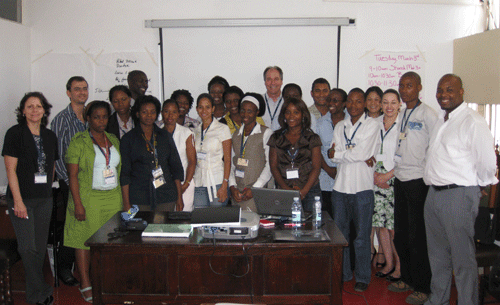
(Paul's Train the trainers group in Nigeria) The 2009 CD4 “train the trainers” class in Maputo Mozambique after the students had competed the “teach back” module where they present the materials taught over the week back to the class. Instructors: Candice Johnson (far left) and Paul Wallace (center back). Also present where two CDC observers from Atlanta, Luciana Kohatsu and Astrid Ortiz (2nd and 3rd from right).
Conclusion.
The ASCP/CDC PEPFAR program started in 2005 with programs in Ethiopia and Kenya and is now providing training and support to 15 countries in not only Africa, but also South America, the Caribbean and Central and Southeast Asia. The program specializes in providing laboratory trainings and technical assistance on basic laboratory operations, CD4 testing, clinical chemistry, hematology, laboratory management and phlebotomy; as well as curriculum development and implementation. An emphasis within all these areas is on improvement of quality control programs for the laboratory diagnosis and monitoring of patients with HIV/AIDS in resource-limited countries. Individuals interested in finding out more information or volunteering should go to http://www.ascp.org/FunctionalNavigation/outreach.aspx
 |
 |
David Grier, MD
Assistant Professor of Pathology
Wake Forest University School of Medicine, Winston-Salem, NC, USA.
|
Paul K. Wallace, PhD
Director of Flow and Image Cytometry Department, Roswell Park Cancer Institute
Associate Professor of Pathology, University of Buffalo, Buffalo, NY, USA
|
References:
1. Celebrating Life: The U.S. President's Emergency Plan for AIDS Relief. In: Office of the U.S. Global AIDS Coordinator USDoS; 2009. http://www.pepfar.gov/documents/organization/113827.pdf
2. Appointment of PEPFAR head should be merit based. Lancet 2009:373(9661):354.
3. Walensky RP, Kuritzkes DR. The impact of the President's Emergency Plan for AIDS Relief (PEPfAR) beyond HIV and why it remains essential. Clin Infect Dis:50(2):272-275.
4. Gilks, C. F., S. Crowley, et al. (2006). "The WHO public-health approach to antiretroviral treatment against HIV in resource-limited settings." Lancet 368(9534): 505-510.
5. Central Intelligence Agency. The World Factbook: Guyana. Updated June 24th,2010. Retrieved July 15, 2010. https://www.cia.gov/library/publications/the-world-factbook/geos/gy.html
6. U.S. Department of State (2008). 2008 Country Profile: Vietnam. http://2006-2009.pepfar.gov/press/81650.htm
This journal article was supported by Cooperative Agreement Number PS001285 from Centers for Disease Control and Prevention (CDC). Its contents are solely the responsibility of the authors and do not necessarily represent the official views of CDC.
|
