
Ask an Expert
Back to Categories
Do I need to test new reagent lots or new shipments of my antibodies?
Yes, this is a new CAP requirement (as of April 2014) and is a phase 2 deficiency if it is not followed:
“The performance of new lots/shipments of antibody and detection system reagents is compared with old lots/shipments before or concurrently with being placed into service.
NOTE: Parallel staining is required to control for variables such as disparity in the lots of detection reagents or instrument function. Comparing the results of the new reagent run in parallel on the same fresh control (patient or normal) is recommended to ensure that the new reagent lot provides a clinically comparable result to the old reagent lot. Testing the new reagent on a standardized control with defined acceptance criteria is also acceptable. Before using a new lot of antibody cocktail, it is recommended to compare each individual antibody by using a side scatter vs. fluorescence plot and having defined acceptance criteria from old lot to new lot. Only when there is agreement between the individual old and new lots should the cocktail be made and then tested against the old cocktail.” (CAP Flow Cytometry Checklist 04/21/2014)
In most instances, a normal peripheral blood can be used to fulfill this requirement. In our laboratory, we routinely follow this process:
- If the lot numbers of the in-use antibody and the new incoming antibody are the same, we set up one tube containing a certain amount of WBCs (usually 500,000) and add the previously titered amount of antibody "in use". A second tube (containing the same amount of cells) is set up adding the same amount of "new" antibody (new shipment). Both tubes are run with the same settings and the dot plots are labeled side scatter versus fluorescence. Evaluation of performance characteristics can be based on intensity (MFI) of the positively stained populations (if there are no "negative" cells, e.g. CD45), signal/noise ratio (if antigen-positive and antigen-negative cells are present within the same population. e.g. CD3) or a combination (MFI of granulocytes/lymphocytes, e.g. CD15). For heterogenous antigens, percent of positive cells could also be considered.
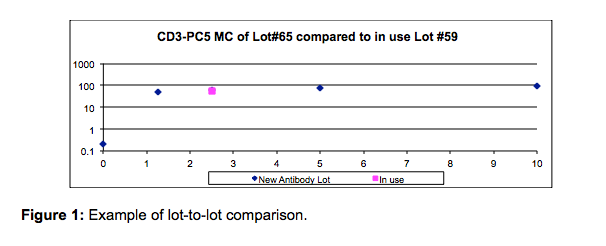
- If the "new" lot number is different than that of the current "in use" lot, then a titration must be done. The "in use" antibody amount is compared to a titration series of the "new" lot starting with the recommended amount, subsequent lesser amounts, or serial dilutions (e.g. 20, 15, 10, 7.5, 5, 2.5, 1.25 and 0.5 microliters). The MFI or signal/noise is recorded and compared to the fluorescence intensity of the internal positive control or to an unstained negative control of the same cell type. This procedure identifies the optimal antibody concentration to be used for the "new" antibody lot.
Further Reading:
1. ICSH/ICCS Workgroup (2013) Validation of cell-based fluorescence assays: Practice guidelines from the International Council for Standardization of Haematology and International Clinical Cytometry Society. Cytometry B Clin Cytom. 84:281.
Author: Andrea Illingworth